Gallery
Mathematical art from chaotic dynamical systems and generative algorithms. Strange attractors, symmetric icons, reaction–diffusion and flow fields, and fractals — each rendered as luminous traces on dark backgrounds.
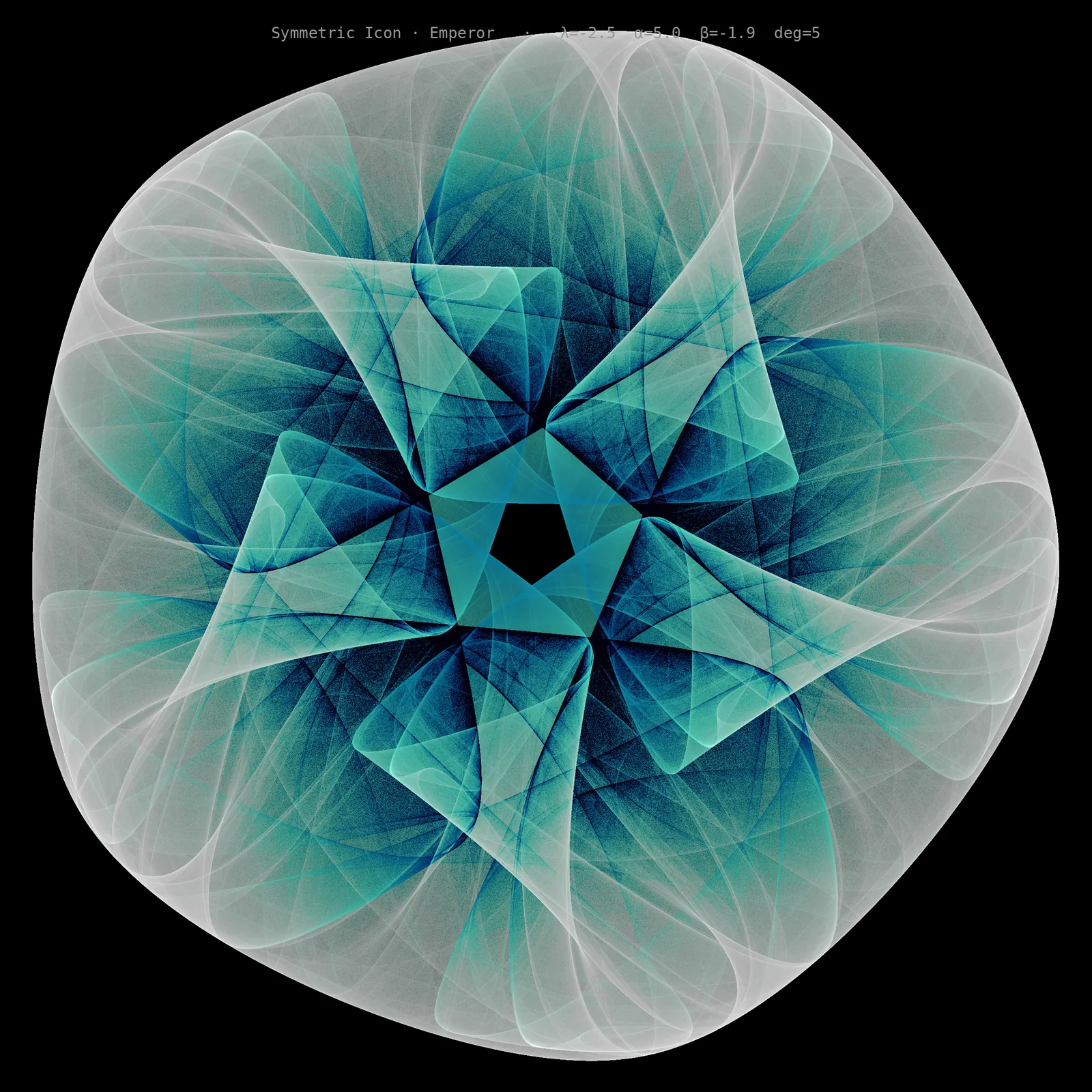
Emperor
A symmetric icon — the strange attractor of a chaotic planar map constrained to five-fold rotational symmetry. Each individual orbit wanders chaotically, but the density it leaves behind over millions of iterations crystallizes into a single ordered bloom. Order emerging from chaos, by construction.
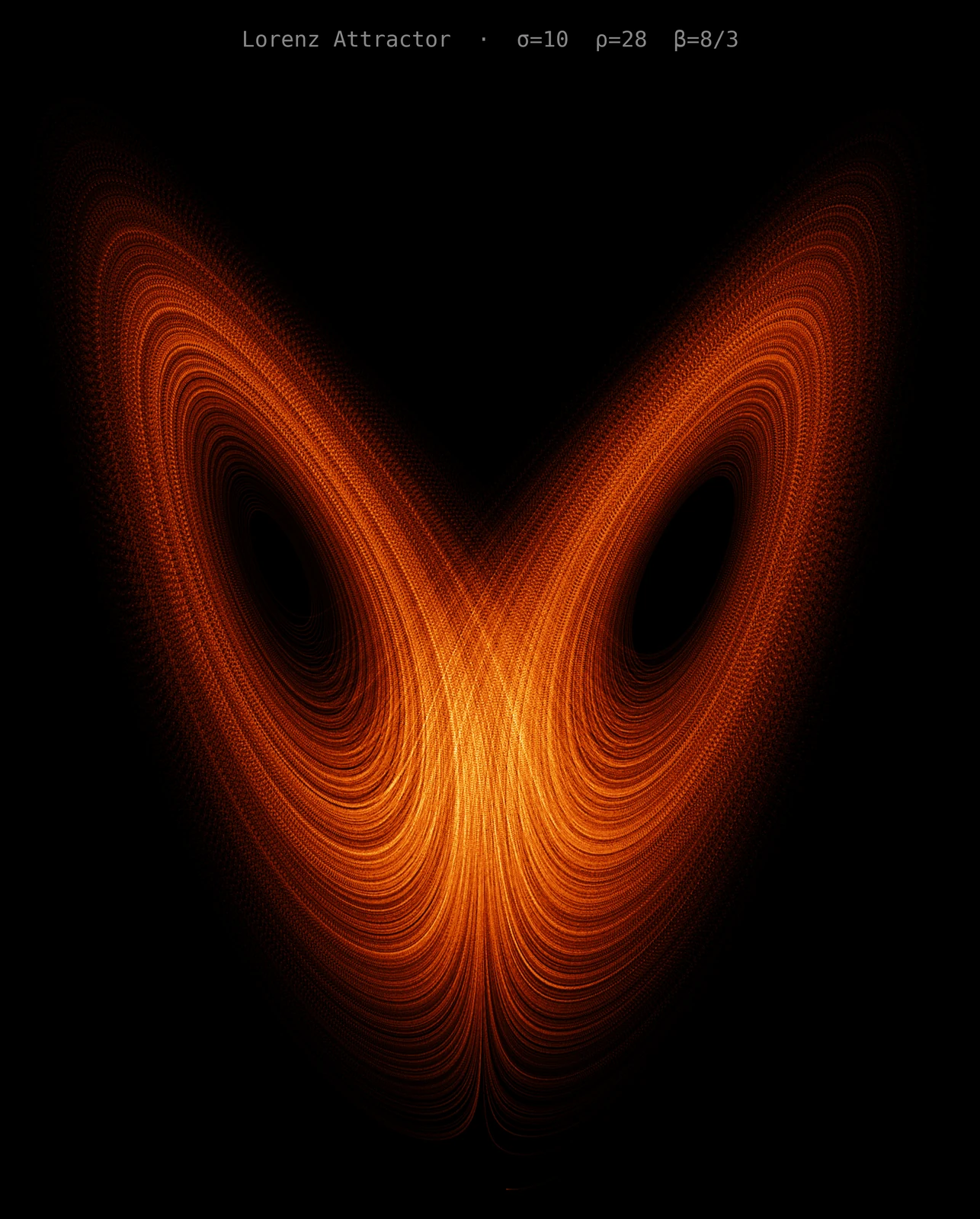
Lorenz Attractor
The system that started chaos theory. Edward Lorenz discovered it in 1963 while modeling atmospheric convection — a deterministic system that never repeats, sensitive to initial conditions down to the 12th decimal place.
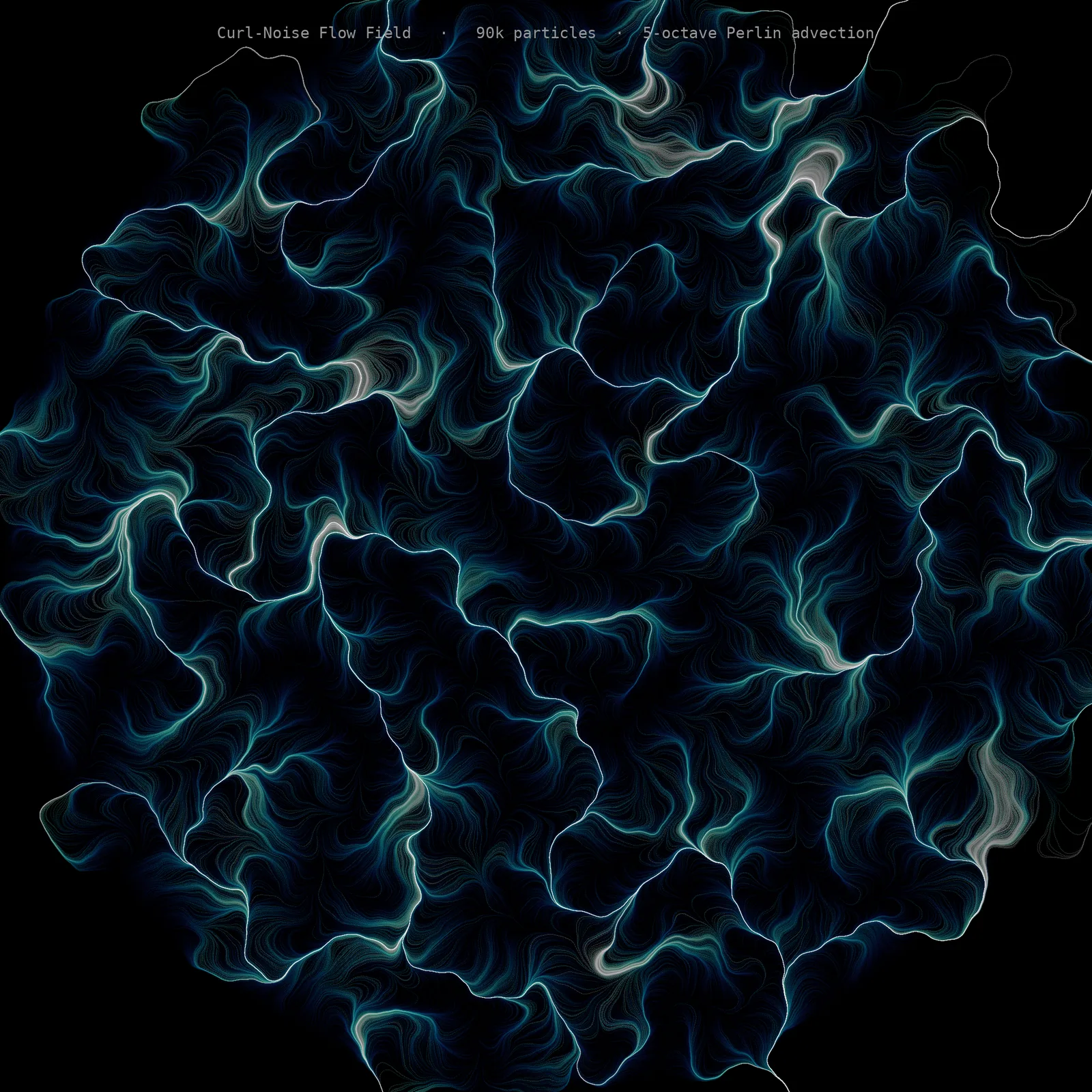
Aurora Flow
Ninety thousand particles released into a divergence-free curl-noise field, each tracing the streamlines of an invisible flow. Because the field is incompressible the particles never bunch or tear — they comb into the filaments of an aurora, motion frozen mid-shimmer.
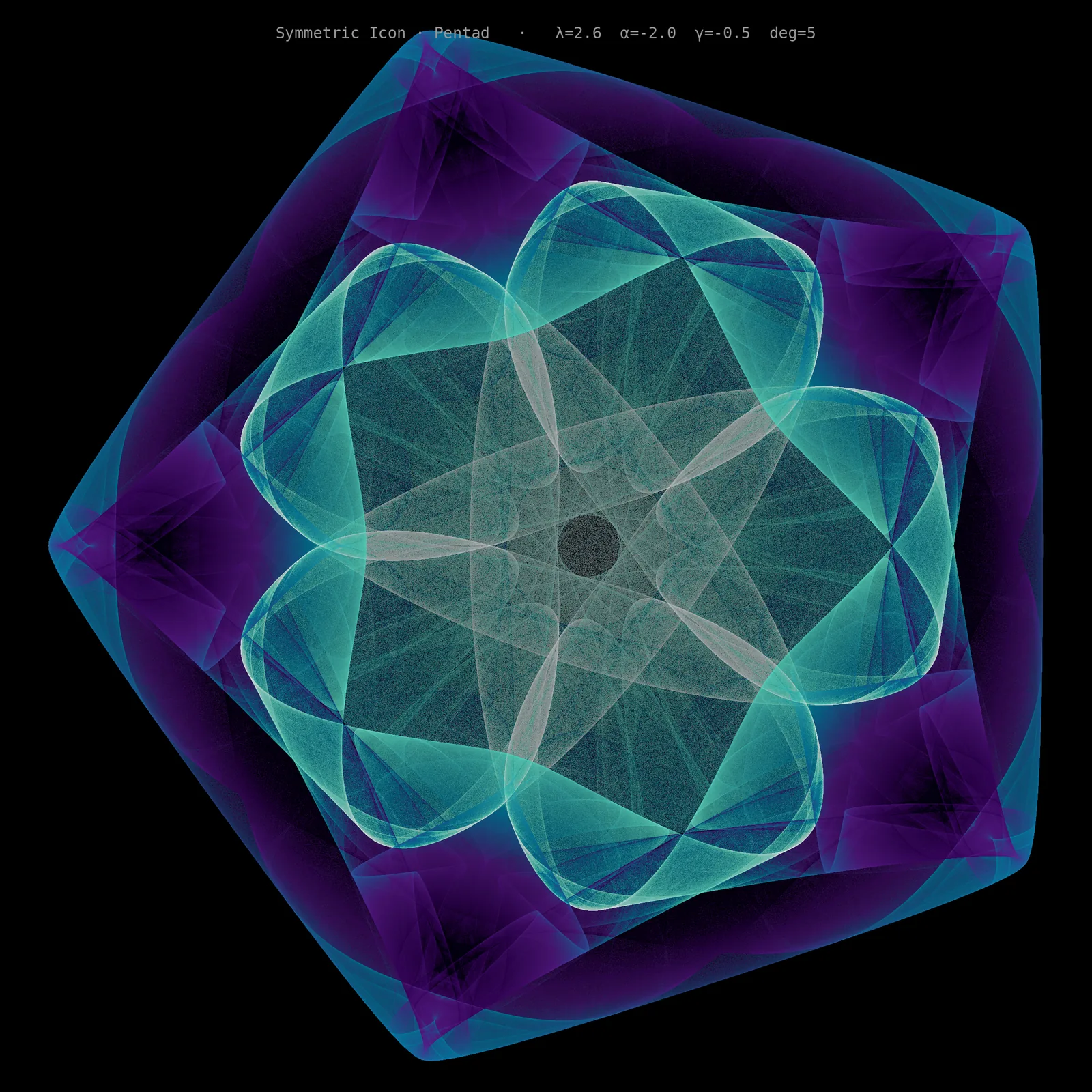
Pentad
Another five-fold symmetric icon, tuned toward sharper petals and harder edges. Where Emperor blooms soft, Pentad locks into a faceted pentagonal star — proof of how violently the same family of maps reorganizes under a small change of parameters.
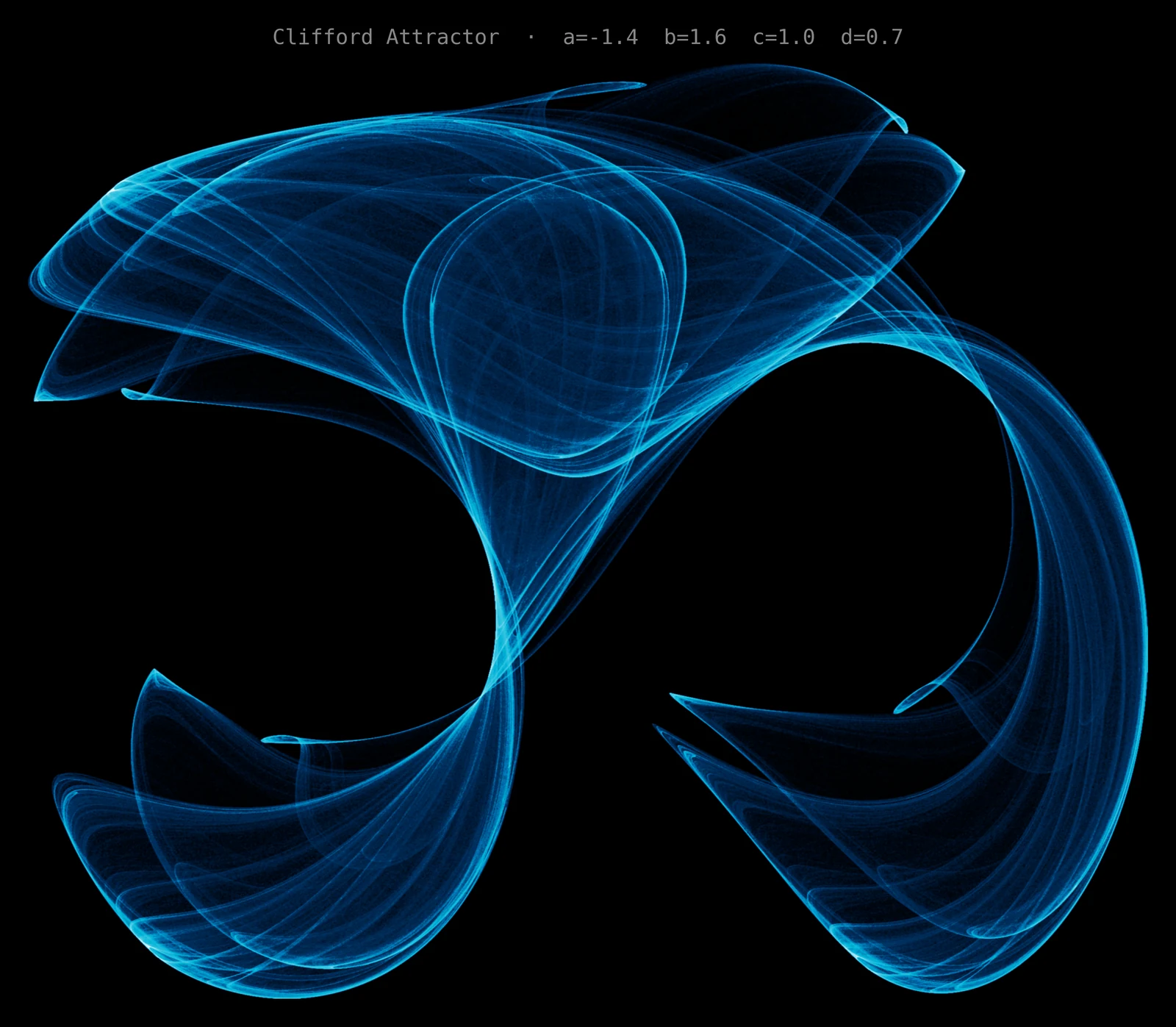
Clifford Attractor
A two-dimensional strange attractor discovered by Clifford Pickover. Four parameters generate an infinite variety of flowing, organic forms — from tight spirals to diffuse clouds — all from a pair of sine/cosine recurrences.
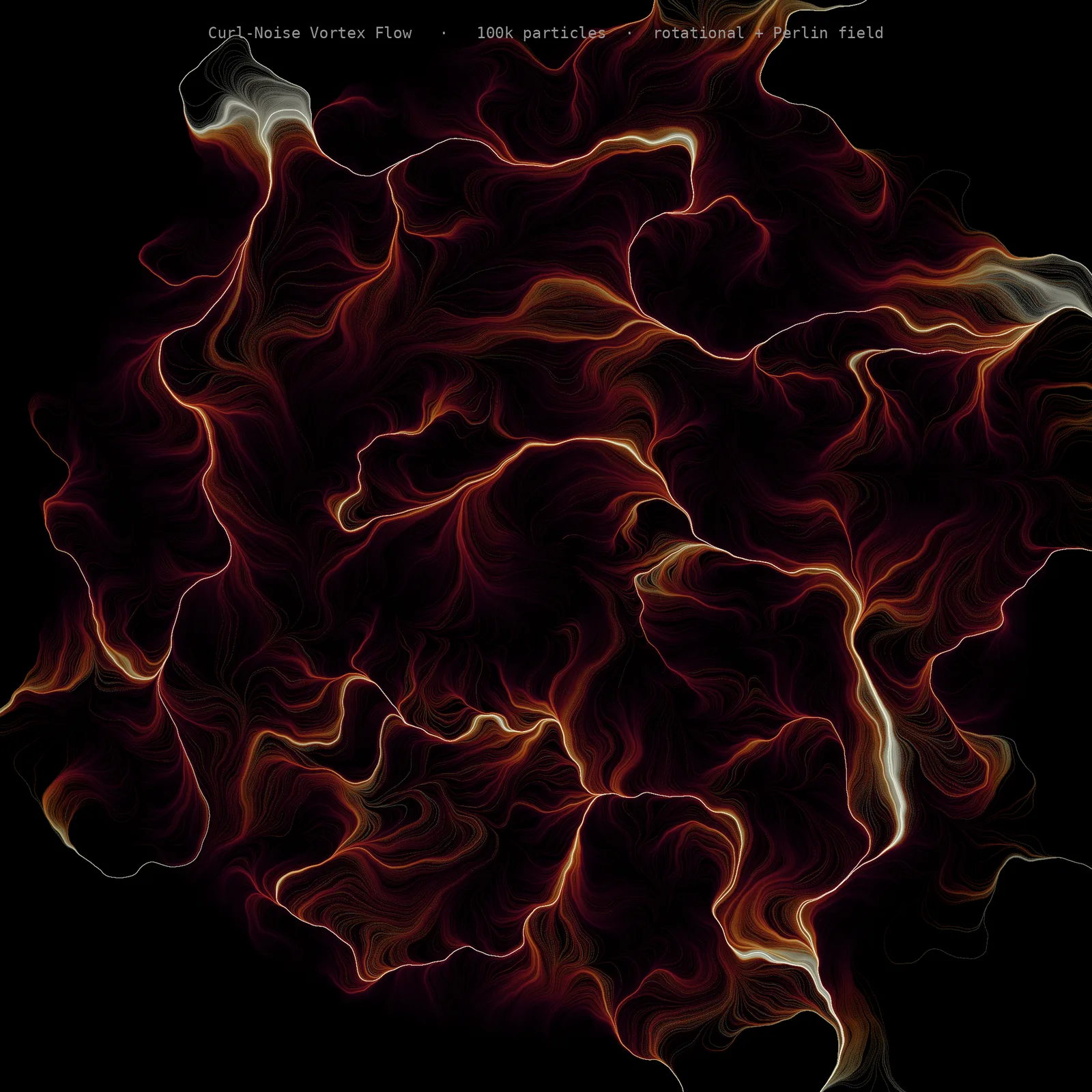
Vortex Flow
The same curl-noise machinery turned hot: a rotational core layered under Perlin turbulence, a hundred thousand particles dragged through it. The streamlines twist into molten ember and smoke — a still photograph of a flame that never actually burned.
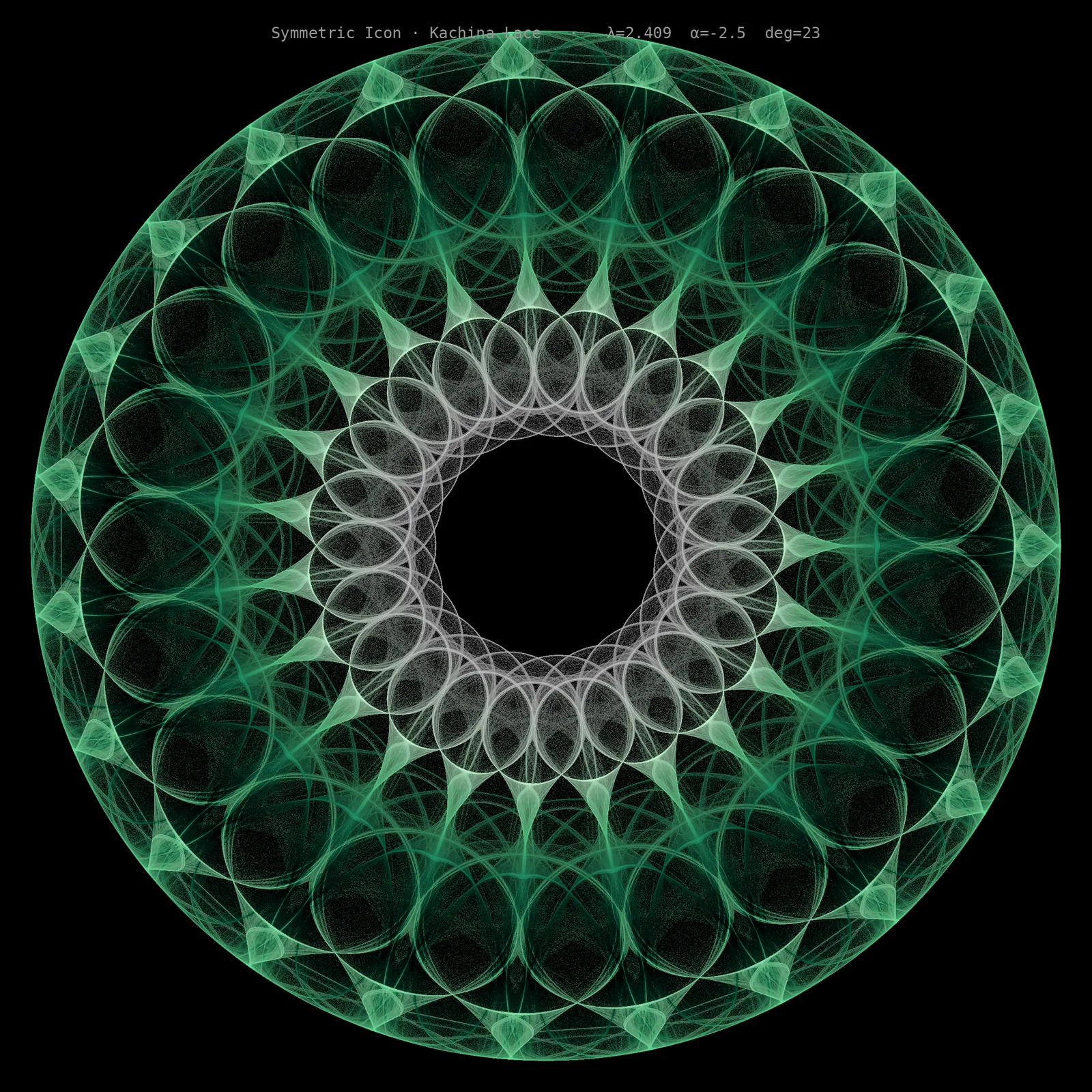
Kachina Lace
A high-symmetry icon from the Field–Golubitsky family, wound to degree 23. The interference of two dozen symmetry axes builds a rose-window lattice of nested rings — chaos averaged into lacework dense enough to read as woven thread.
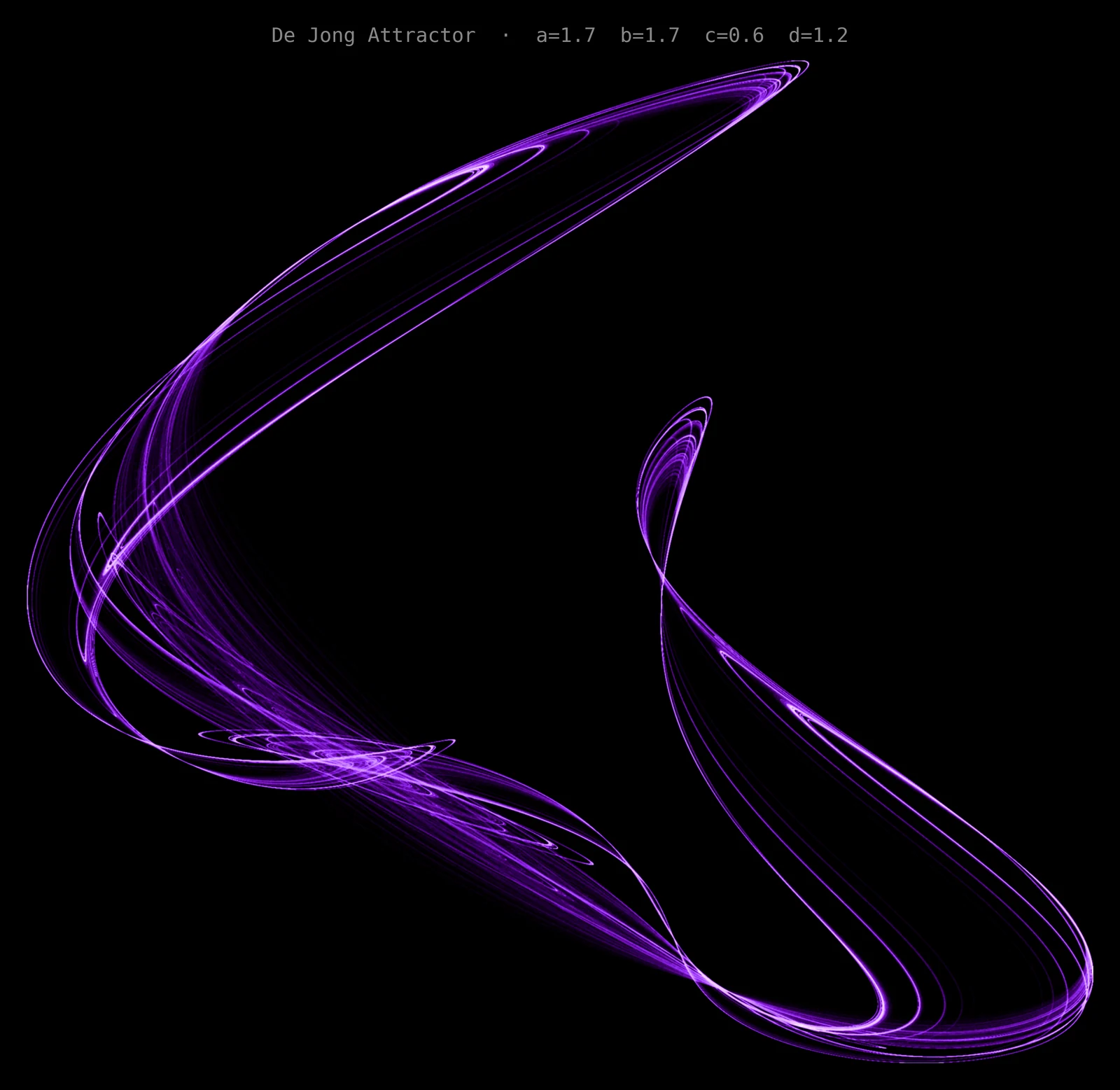
De Jong Attractor
Peter de Jong's iterated map produces intricate lacework from pure trigonometry. Tiny parameter shifts collapse structure into noise or unfold new symmetries — a sharp reminder that complex beauty lives at the edge of instability.
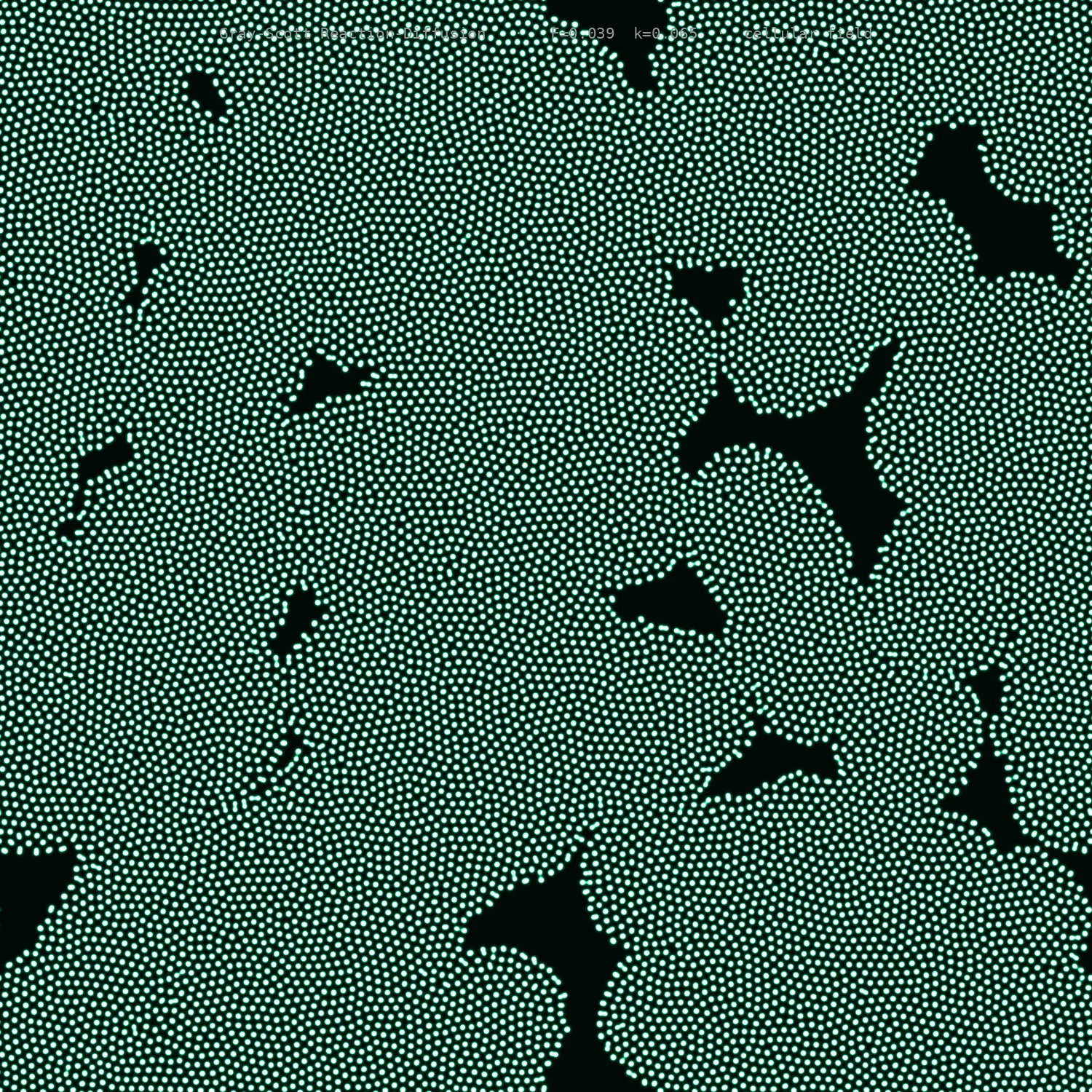
Gray–Scott Field
A reaction–diffusion system: two virtual chemicals, one feeding the other, diffusing across a grid. From a near-uniform start the field spontaneously breaks into cells, fingers, and voids — the same class of process Alan Turing proposed in 1952 to explain spots, stripes, and the patterns of living skin.
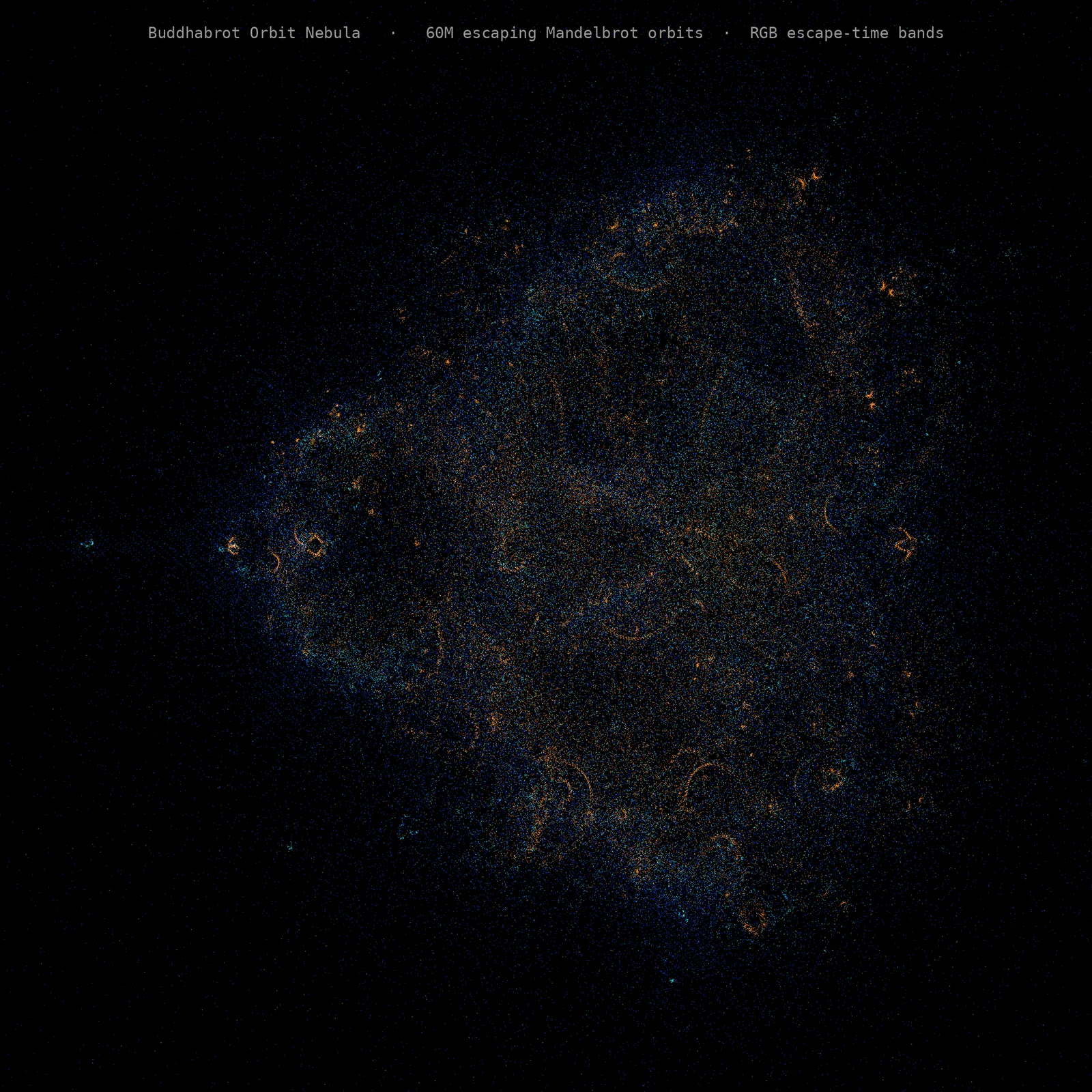
Buddhabrot Nebula
The Buddhabrot — a Mandelbrot set rendered inside-out. Instead of coloring points by whether they escape, it traces the paths of millions of escaping orbits and lets their crossings accumulate. The familiar bug-shaped silhouette dissolves into a ghostly nebula of probability.
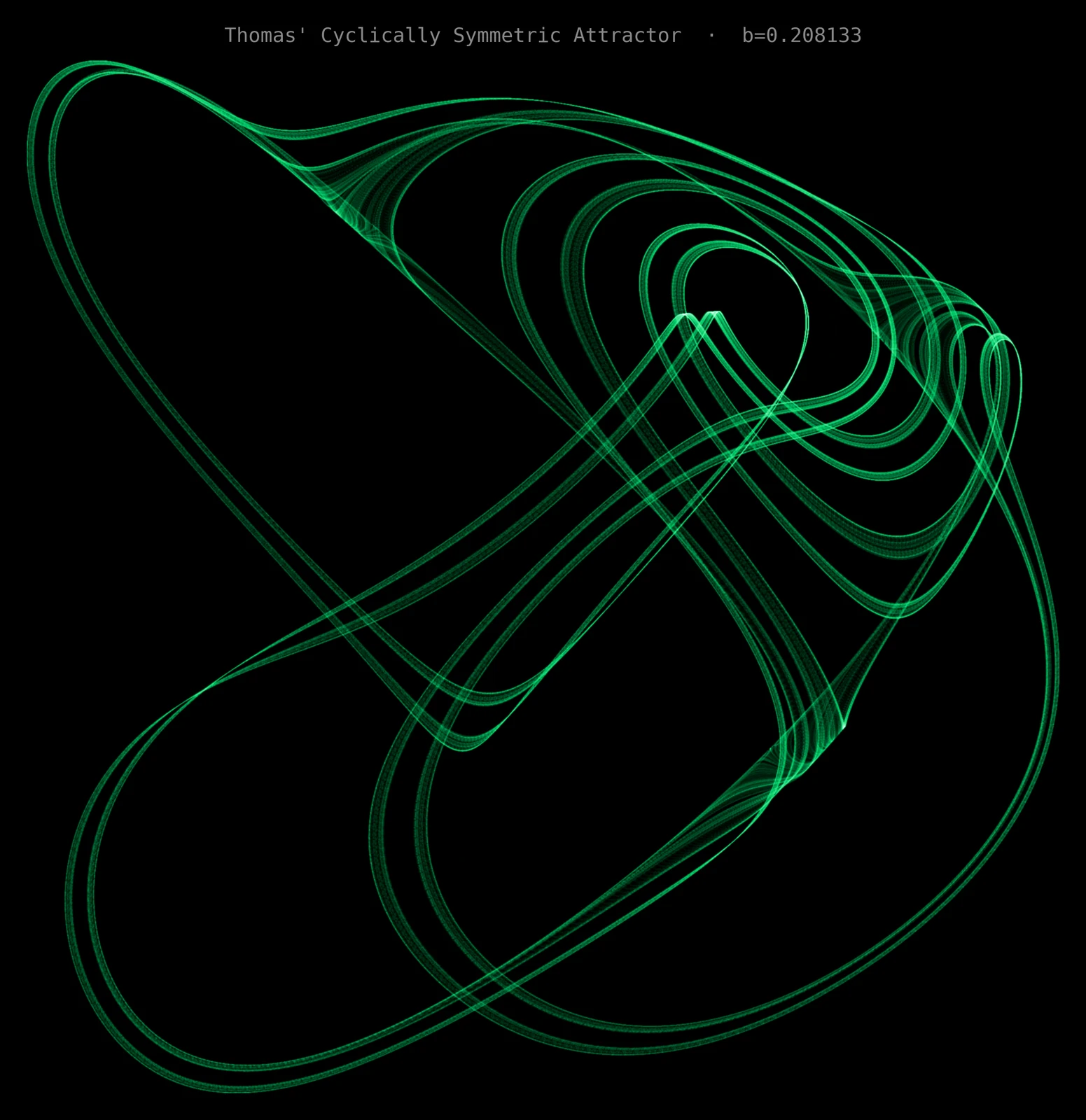
Thomas' Attractor
René Thomas designed this system to model particle motion with damped feedback. The result is an attractor with unusual three-fold symmetry — orbits wind through three interlinked lobes, producing dense, luminous knots.
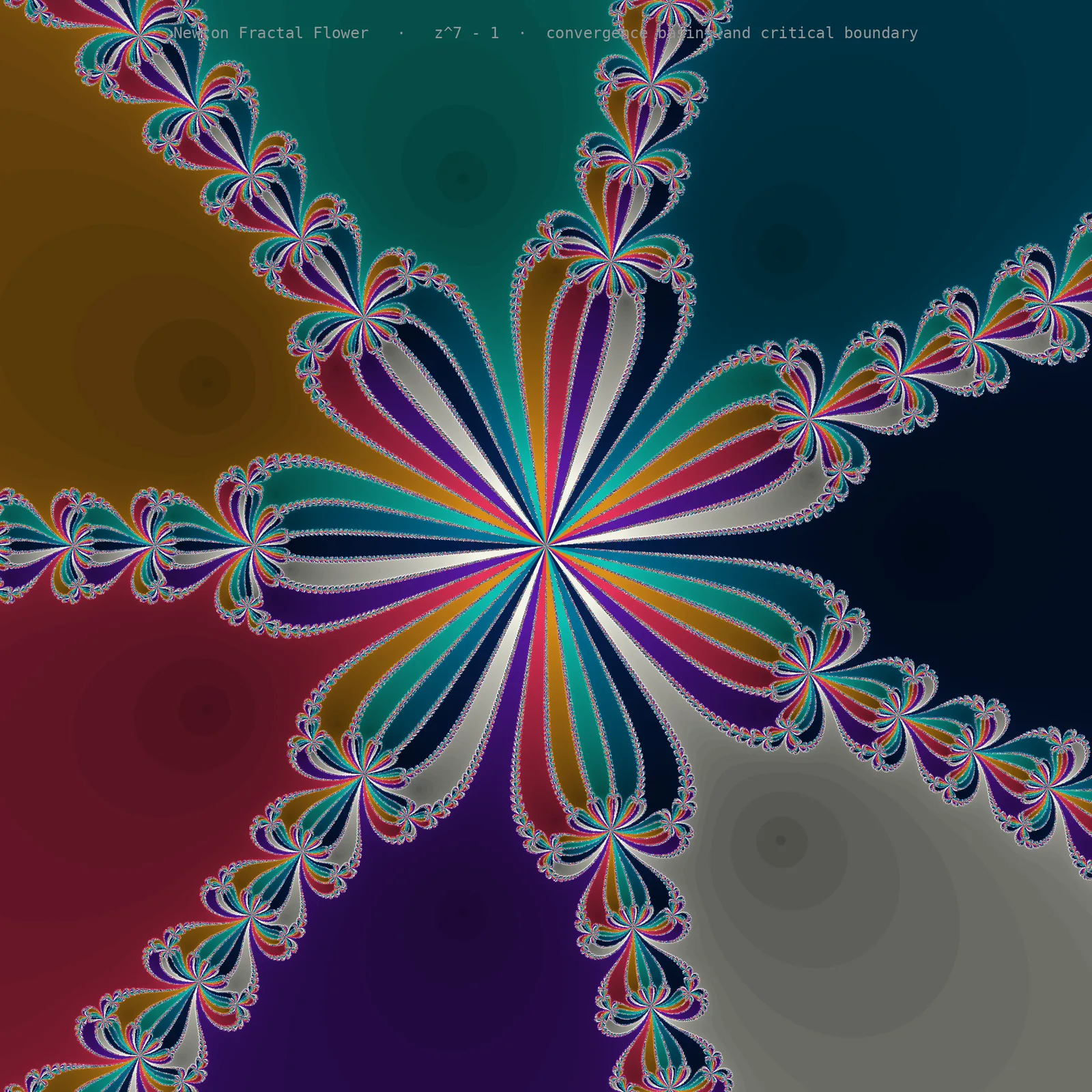
Newton Flower
Newton's root-finding method, run across the complex plane for z⁷ − 1. Each pixel is colored by which of the seven roots it converges to — and the boundaries between those basins are fractal, infinitely intricate. A 17th-century algorithm for solving equations, caught misbehaving beautifully.
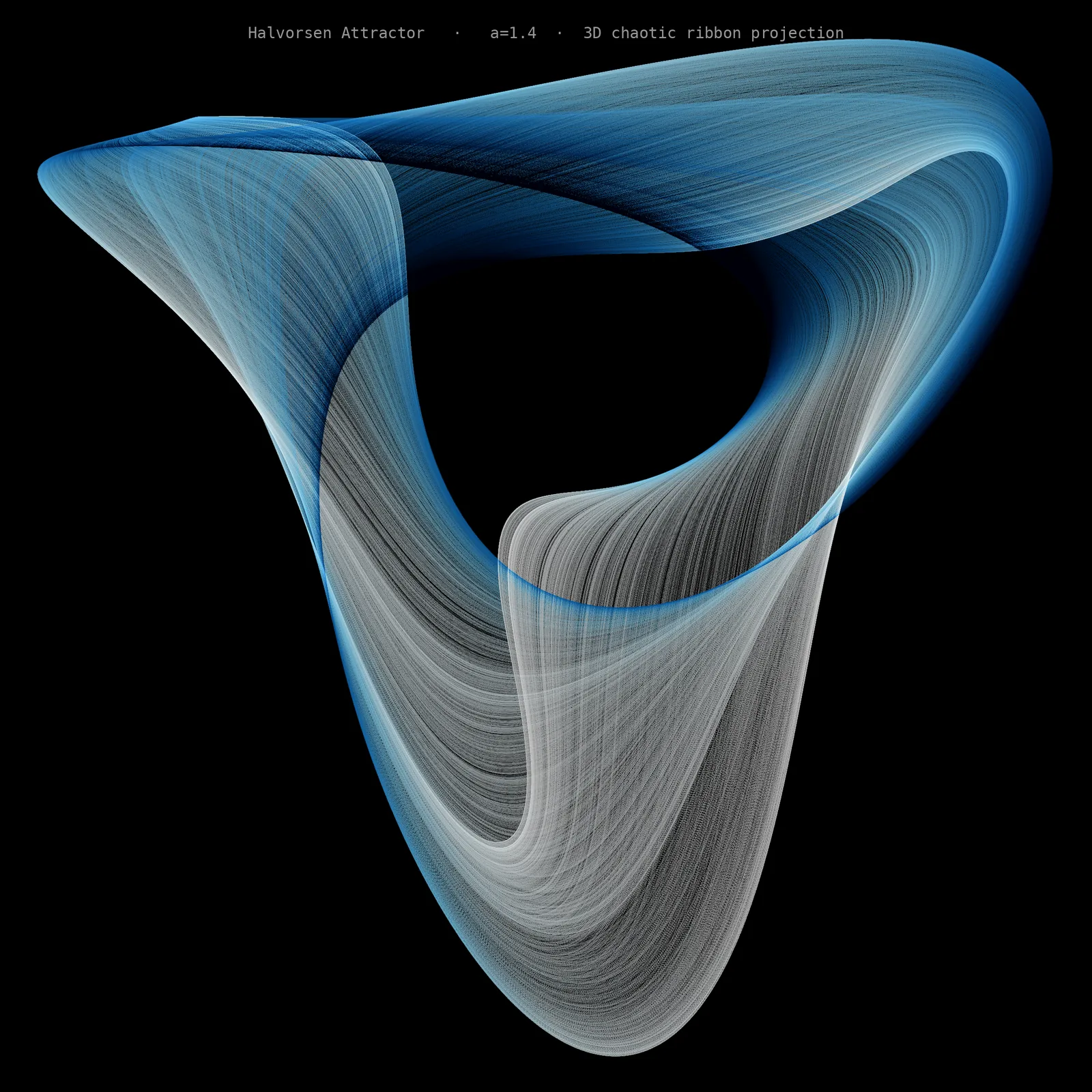
Halvorsen Ribbon
The Halvorsen attractor, a cyclically symmetric system of three coupled equations. A single trajectory loops through three linked lobes, laying down a ribbon that carries the same three-fold symmetry in every direction — order you can read from any angle.
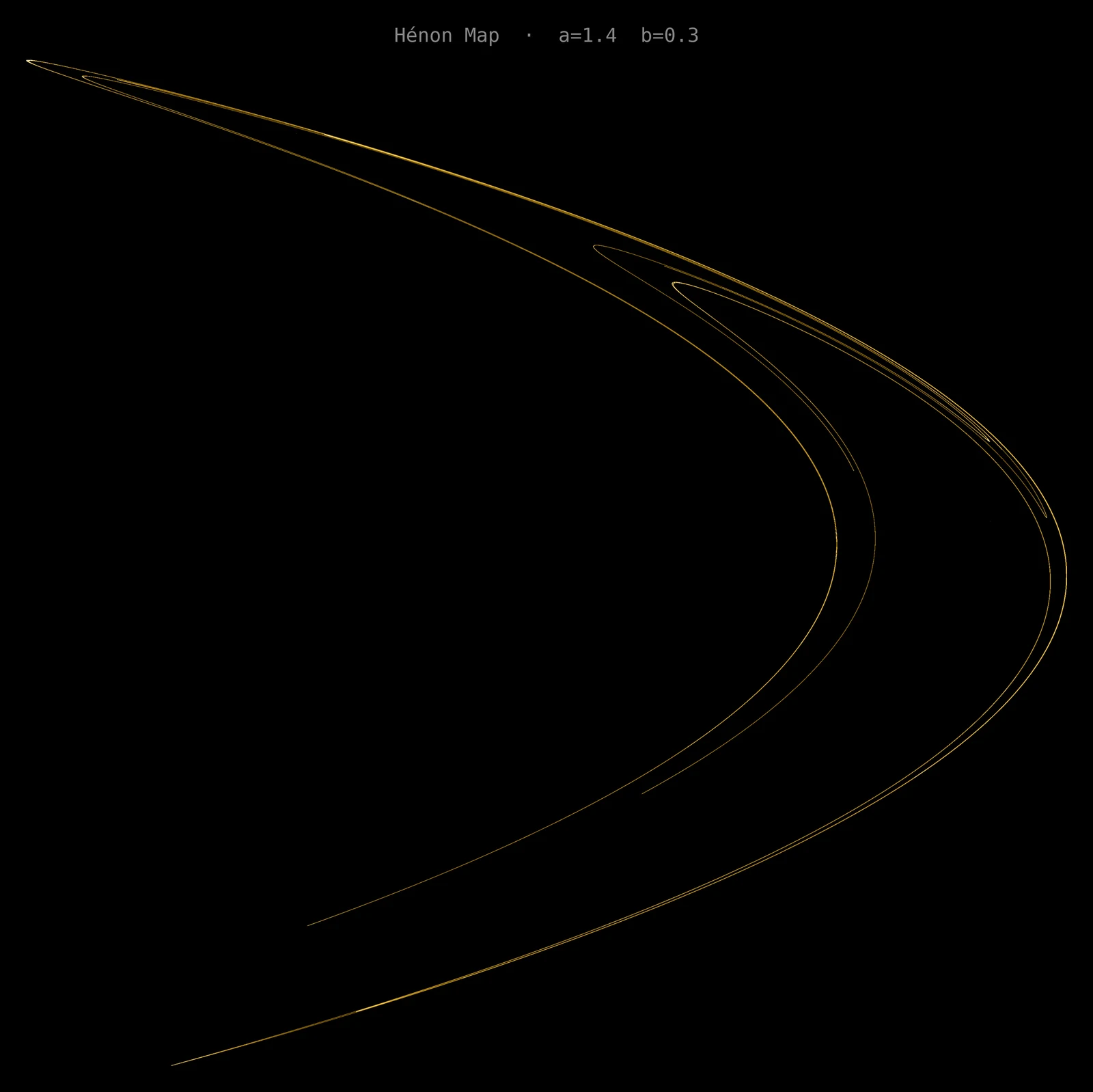
Hénon Map
Michel Hénon's 1976 map is one of the most studied discrete dynamical systems. Its fractal structure reveals self-similarity at every scale — zoom in anywhere and the same filamentary pattern reappears, infinitely nested.
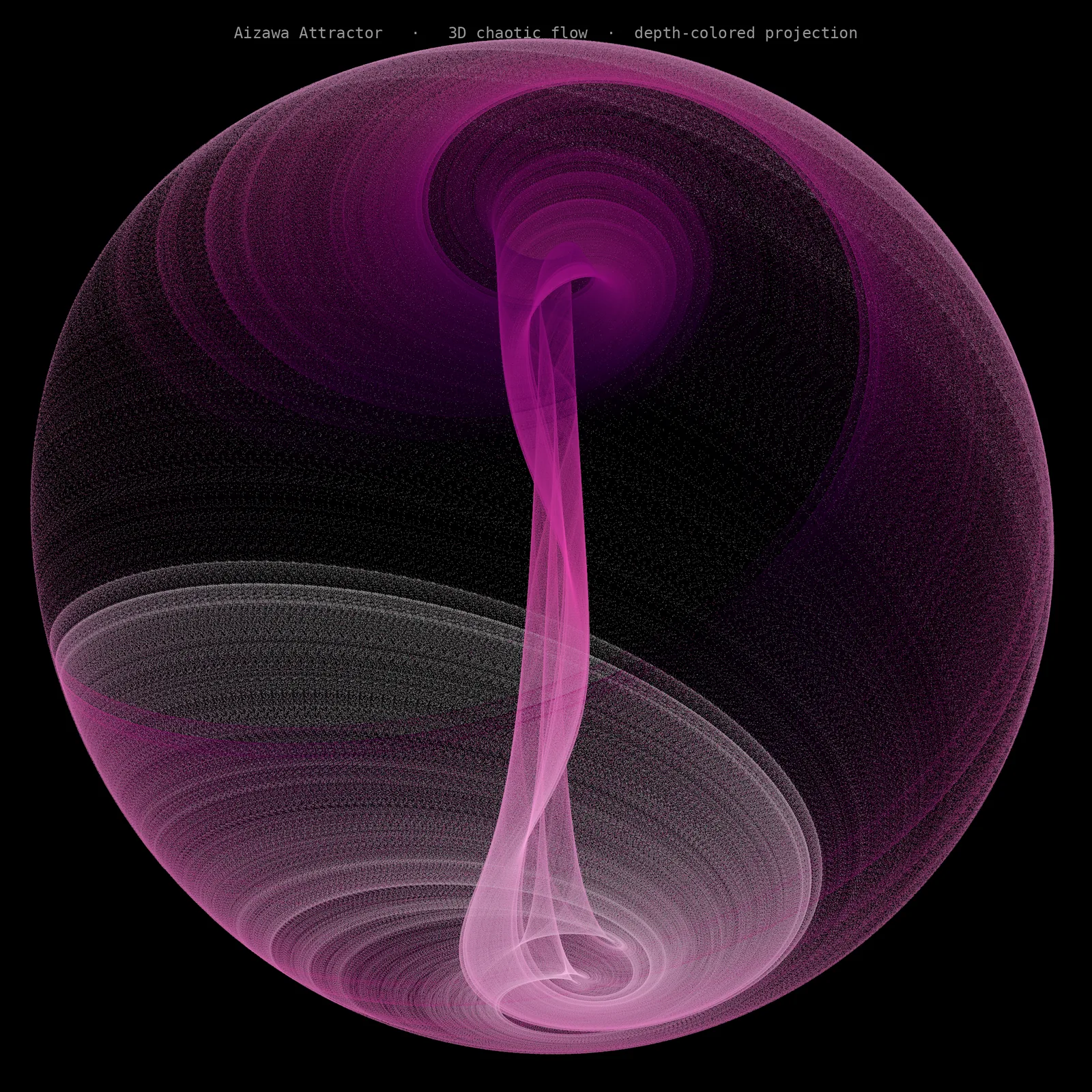
Aizawa Hourglass
The Aizawa attractor: a three-dimensional flow that folds an orbit into a spherical shell pierced by a central spindle. Trajectories spiral up the axis, flare across the surface, and fall back — never closing, never escaping, tracing an hourglass that holds its own sand.
The process
Most of these are computed by iterating a simple rule millions of times — a recurrence, a flow, a reacting field. The images aren't photographs or simulations; they're records of where the math spent its time. Every pixel's brightness is proportional to how often an orbit, a particle, or a reacting cell visited that region of space.
The coloring comes from mapping density — or escape, or convergence — to a hand-tuned ramp. High-density regions glow hot; sparse regions fade to black. No post-processing, no filters — just mathematics and a careful choice of palette.